AI novel writing software should understand more than the next paragraph.
The short answer: good AI novel writing software should help an author draft, organize, check, revise, and finish a whole book while preserving manuscript ownership and final creative control. It should remember what the story establishes, show where its conclusions came from, and make its privacy boundary plain.
By Chris Kantz, novelist and founder of Epoch Studio · September 17, 2026 · 9 minute read
The whole-book test
A writing demo can look brilliant for five minutes. A novel asks whether the same tool still helps after fifty chapters.
- 01Can you keep control of the manuscript?
- 02Can it follow the whole book?
- 03Can it show its evidence?
- 04Does the author decide canon?
- 05Is the privacy boundary real?
- 06Can the work leave intact?
- 07Are the limits stated plainly?
What is AI novel writing software?
AI novel writing software is a writing environment that uses a language model to assist with work such as planning, drafting, revision, story analysis, and continuity. The useful distinction is not whether a product can generate prose. Almost any general chatbot can do that. The distinction is whether the software can support the shape and memory of a complete novel.
Book writing software also has to do ordinary, unglamorous work well: keep chapters in order, preserve revisions, connect notes to the manuscript, and export a usable book. AI is one part of that environment—not a substitute for it.
Seven questions before you trust it with a book
This is the test I wish I had when a long manuscript outgrew the pile of disconnected tools around it.
01
Can you keep control of the manuscript?
You should be able to edit the actual book, preserve revisions, reject suggestions, and know exactly when generated text becomes part of your work. Assistance should arrive as a proposal. Nothing should quietly rewrite the source.
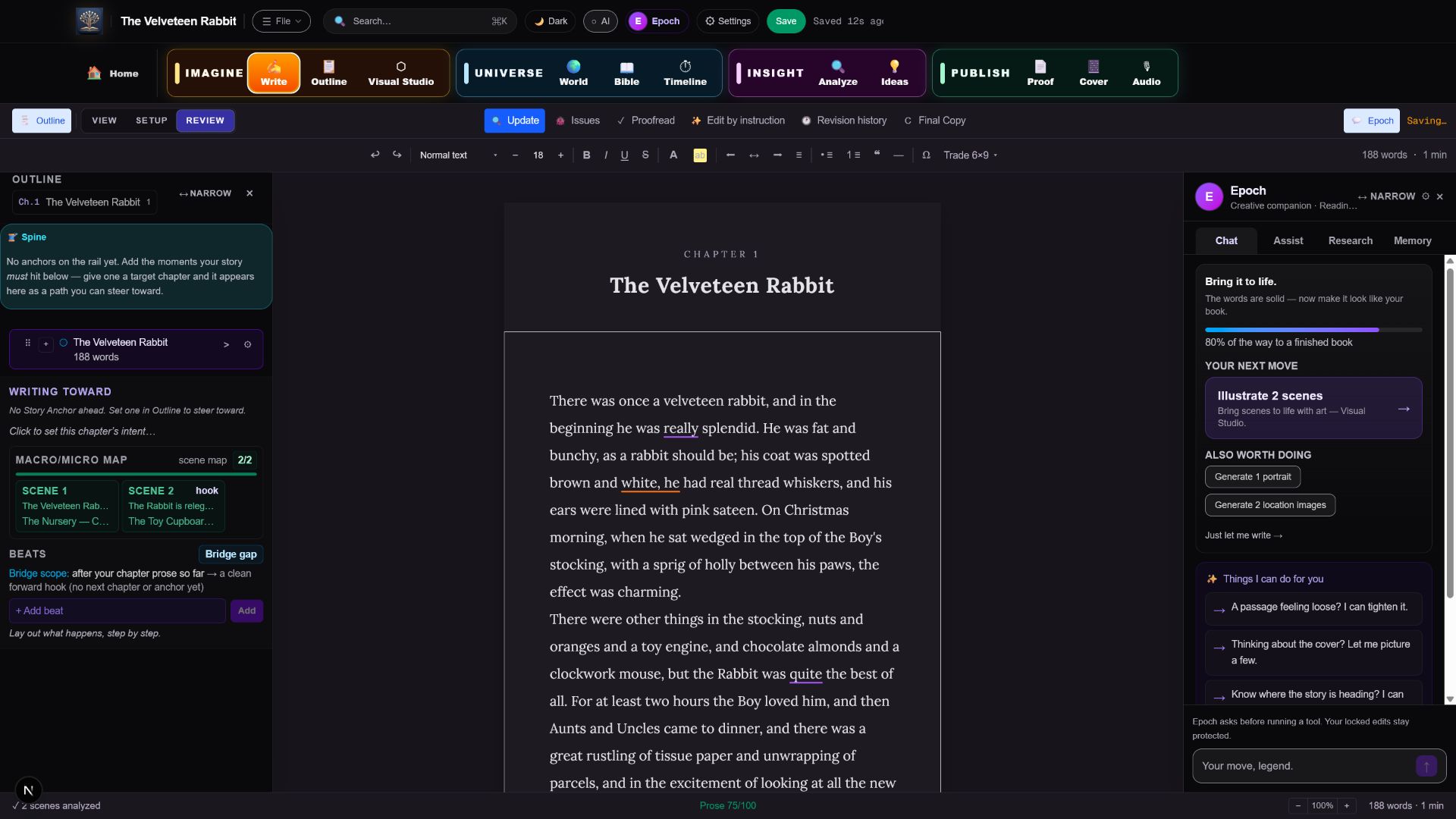
Epoch's answer: author edits remain authoritative, and AI output does not become canon unless the author keeps it.
02
Can it follow the whole book?
A chapter is not an isolated prompt. People change, promises echo, locations matter, and knowledge moves unevenly between characters. Ask whether the tool maintains a working model of those relationships or merely resends a note file with every request.
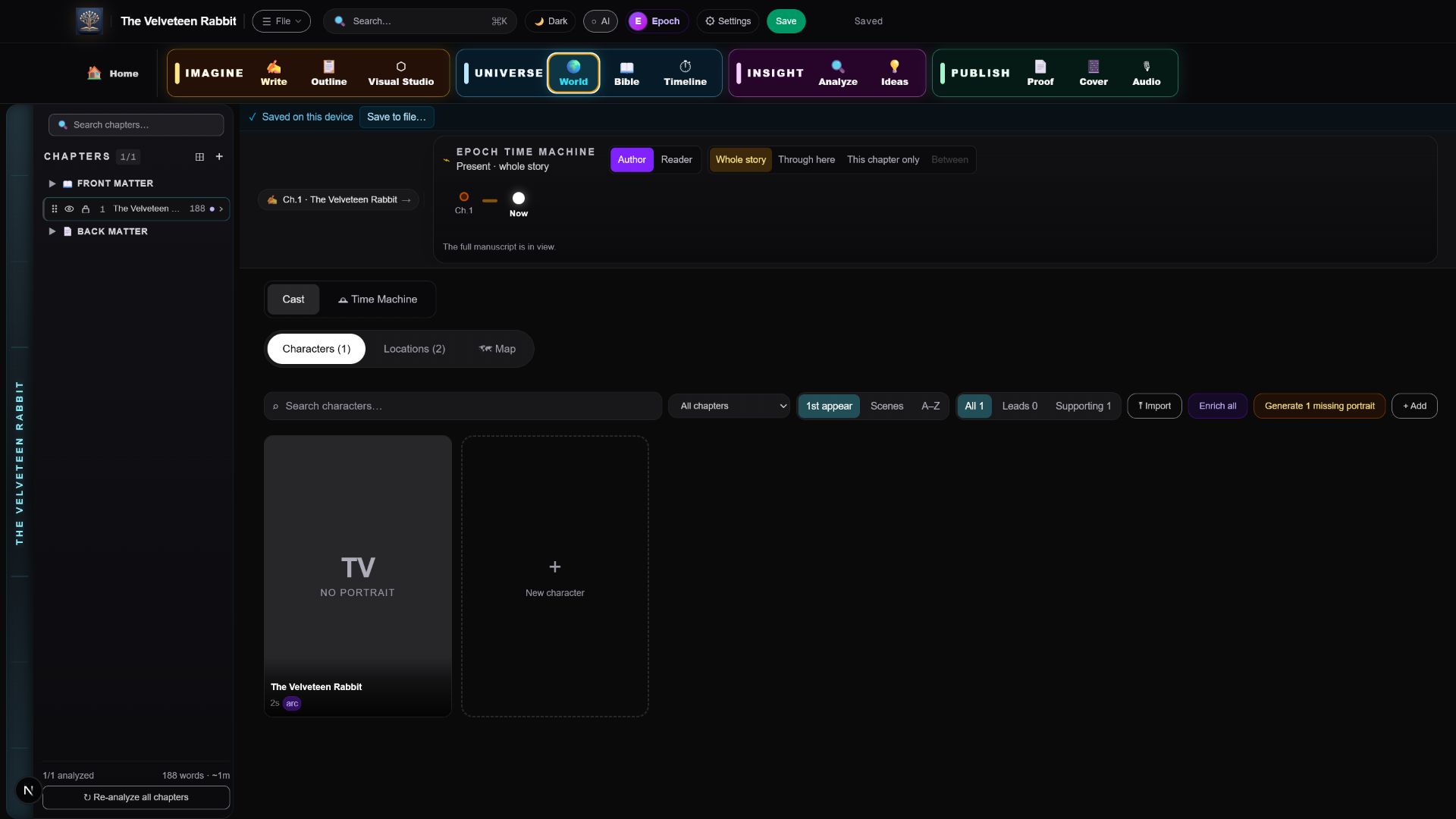
Epoch's answer: it builds a living story model from the manuscript—cast, locations, events, relationships, chronology, open threads, and character knowledge.
03
Can it show why it believes something?
“This is inconsistent” is not enough. Useful analysis should lead back to the relevant passage, distinguish an observation from an inference, and let the author judge the result. Evidence makes a warning inspectable instead of merely confident.
Epoch's answer: story-world claims retain routes back to manuscript evidence, so continuity findings can be examined rather than accepted on faith.
04
Does the author decide what is true?
A contradiction may be a mistake. It may also be a mystery, a lie, a dream, an unreliable narrator, or a deliberate change. Software can surface the collision; it should not flatten every ambiguity into an error or decide the story for you.
Epoch's answer: the engine separates what the manuscript establishes from what a character claims, then leaves the creative ruling to the author.
05
Is the privacy boundary concrete?
“Private” should name an architecture. Find out where project files live, which features work with a local model, what requires an outside provider, and whether an account or subscription is required to open your own work.
Epoch's answer: projects live on the author's device, supported downloadable models can run locally on compatible hardware, and optional cloud providers are a deliberate choice.
06
Can it help finish the artifact?
A novel is not finished when a chatbot stops typing. Look for the path from chapters to revision, page composition, cover work, proofing, and export. Your structure and decisions should remain useful all the way to the files readers receive.
Epoch's answer: writing, analysis, illustration, covers, audio, proofing, and PDF, EPUB, Word, and portable-project export stay connected to the same book.
07
Are the limits as visible as the promise?
Local models need disk space, memory, and often a compatible graphics device. AI can miss context and misread prose. A serious tool should state its platform, product stage, and hardware tradeoffs before asking for trust.
Epoch's answer: it is a Windows alpha. The product is real and working, but some rooms are deeper than others, and Linux and Steam Deck are not supported today.
What “whole book” looks like in Epoch
World is not a folder of character cards beside the manuscript. It is a view of what the book has established, where it was established, who knows it, and how that understanding changes over time.
That same model supports continuity checks, scene work, character conversations, illustrations, and the final edition. One source; different rooms.
Who this kind of software is for
Epoch is being built for novelists, memoirists, series writers, and worldbuilders whose work has become too interconnected for a plain document and too private for an invisible cloud workflow. It is especially relevant when continuity, provenance, local control, and finishing the actual book matter more than producing the greatest possible volume of text.
If all you need is occasional brainstorming or a disposable first paragraph, a general chatbot may be enough. If you need collaborative cloud editing across a large team today, Epoch is not designed around that job.
The honest status
Epoch Studio is in alpha for Windows. Playtest access is managed through Steam, and the public store page is the reliable source for availability. The planned product is a one-time purchase rather than a writing subscription.
This guide describes the standard Epoch is built to meet. It does not claim perfect analysis, finished cross-platform support, or a benchmark result we have not established.
See the software, not just the argument
The deeper product tour shows the real Write, World, Analyze, and Proof rooms. The local-AI guide explains the storage, model, and network boundary in plain language.
Walk through the connected studio →
See exactly what local-first means →
Start with the words.
Build everything around them.
Epoch Studio is one private workspace for writing the book, understanding its world, and carrying it to a finished edition.