Local AI writing software should bring the intelligence to your book.
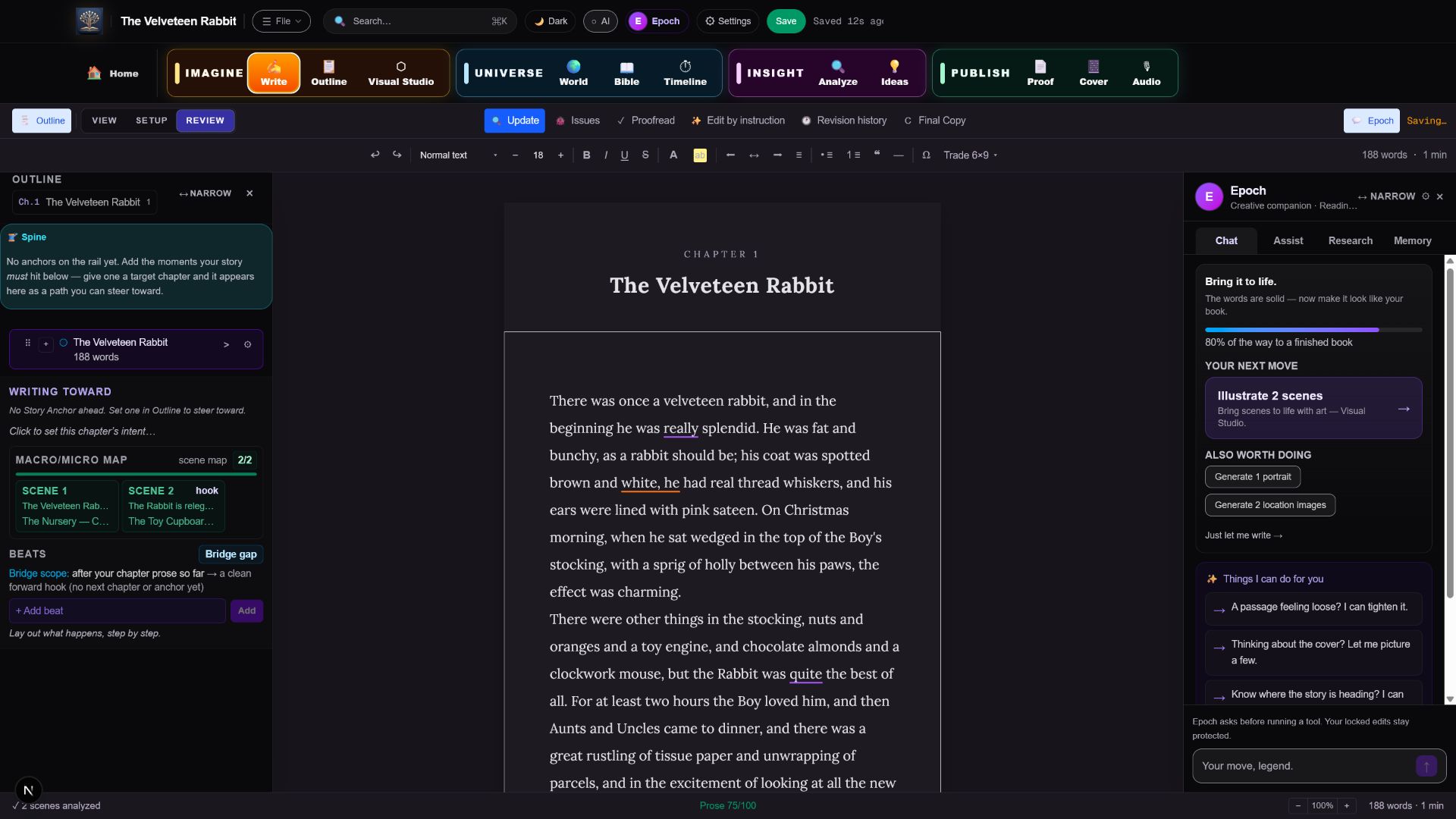
Epoch Studio is private, local-first AI writing software for authors. It keeps your manuscript and project on your computer, supports downloadable local models, and connects drafting, story continuity, illustration, proofing, covers, audio, and export in one desktop workspace.
A practical answer from Chris Kantz · Updated September 8, 2026 · 8 minute read
The short answer
“Local AI” should describe architecture, not atmosphere. Your project should remain readable and editable on your own machine. A local model should be able to help without metered tokens or an always-on account. The software should plainly state whether a hosted AI path exists and what, if anything, leaves the device.
That is the standard Epoch Studio is built around. It is not a promise that every computer can run every model, or that an internet connection is never useful. It is a promise that your unpublished book is not trapped inside our service—because Epoch Works does not operate the creative-work server in the first place.
What “local-first” means here
For the exact network and data boundaries—not a simplified marketing version—read the Epoch Studio privacy policy.
What can stay on the machine?
| Work | Local path | Outside connection |
|---|---|---|
| Write and organize | Manuscript, chapters, scenes, story world, revision, and project files | Not required |
| Text assistance | Supported local language models on compatible hardware | No hosted AI provider path |
| Images | Supported local image models on compatible hardware | No hosted image provider path |
| Proof and export | Interior layout, cover work, PDF, EPUB, Word, and project export | Not required |
Hardware matters. Local models need disk space, memory, and—in many cases—a compatible graphics device. Epoch detects what the machine can reasonably run instead of pretending one download fits every computer.
Private is necessary.
Useful is harder.
A private chatbot beside a document is still a chatbot beside a document. A novel has people, places, promises, disputed facts, chronology, changing relationships, and information that one character knows while another does not.
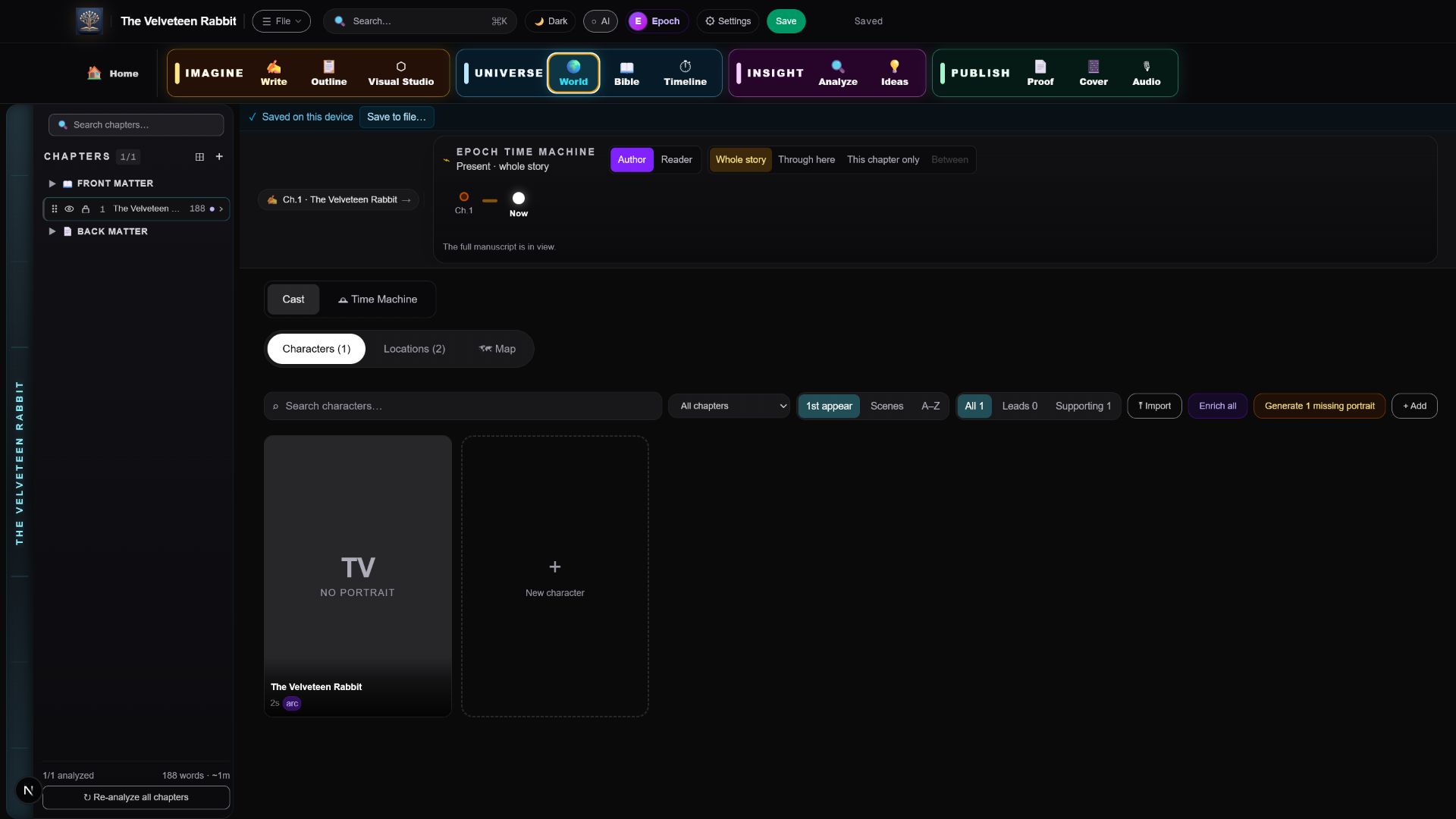
Epoch reads that structure from the manuscript and keeps a route back to the source. That living model follows the work into the editor, analysis rooms, illustrations, page composition, proof, cover, and audio. The point is not merely to generate private prose. It is to help the author keep an entire book coherent.
Questions to ask any local AI writing tool
- Can I open and edit my book without signing in?Local storage is different from a cached copy of a cloud account.
- Which operations work offline?“Local-first” should not hide a mandatory server behind its most important feature.
- Can I choose the model?A model that fits a workstation may not fit a laptop, and no single model is best at every writing task.
- Does analysis cite my manuscript?An unsupported warning is another opinion. Evidence lets the author judge it.
- Can I leave with the whole project?Finished files matter, but so do the structure, decisions, and work that produced them.
- Who decides what becomes canon?Software can surface a conflict. The author decides whether it is a mistake, mystery, lie, or deliberate change.
Choosing the wider writing environment too? Read the seven-question guide to AI novel writing software.
Where Epoch stands today
Epoch Studio is a real alpha, preparing to launch on Windows first. macOS and Linux releases are planned. Some rooms are deep; some edges are still rough.
The product is planned as a one-time purchase without a writing subscription. Direct purchase is not open yet. The honest place to follow availability is the Launch Desk.
Why I built it this way
I did not begin with a market category. I began with a long book. Its characters changed, promises echoed across chapters, and the tools around the manuscript kept treating each request like an isolated prompt.
I wanted one place that could understand the work without claiming it. That is still the test: does Epoch help an author see more clearly, keep control, and finish the actual artifact?
Your machine. Your files.
Your book still yours.
See the real studio, follow the alpha, and decide whether Epoch belongs in your writing life.