A novel does not have one kind of truth.
Epoch Studio is an AI novel continuity checker that follows more than names and notes. It models characters, locations, events, relationships, chronology, open threads, and what each character knows—then keeps a path back to the manuscript so the author can judge every useful claim.
Inside the Epoch Engine · Chris Kantz · Updated September 8, 2026 · 7 minute read
The sentence
She returned the key to Amon, although he had never seen it before.
Mistake, mystery, or lie?
Software should not decide. It should make certain the author saw the collision.
Worked example from Chris's manuscript, The Nile's Redemption.
What is a novel continuity checker?
A novel continuity checker compares what a manuscript says across scenes and chapters. Useful checks can include physical facts, character traits, locations, event order, relationships, promises, unresolved threads, and whether a character acts on information they could not yet possess.
The difficult part is not collecting facts. Fiction contains mistaken beliefs, lies, aliases, flashbacks, secrets, unreliable narrators, and deliberate contradictions. A warning without context can flatten all of that into noise. Epoch keeps evidence and author authority attached to the warning.
A story bible is a reference. A continuity engine is a relationship.
A conventional story bible can say that Amon owns a key. That is useful. But the manuscript may also need to know when he lost it, who witnessed the loss, whether Nefera knows it belongs to him, and which chapter first established each claim.
The Epoch Engine keeps those pieces connected instead of flattening them into one permanent description. The result can support a prompt, an analysis, a character conversation, or an interactive scene without pretending every character knows everything the author knows.
What the engine follows
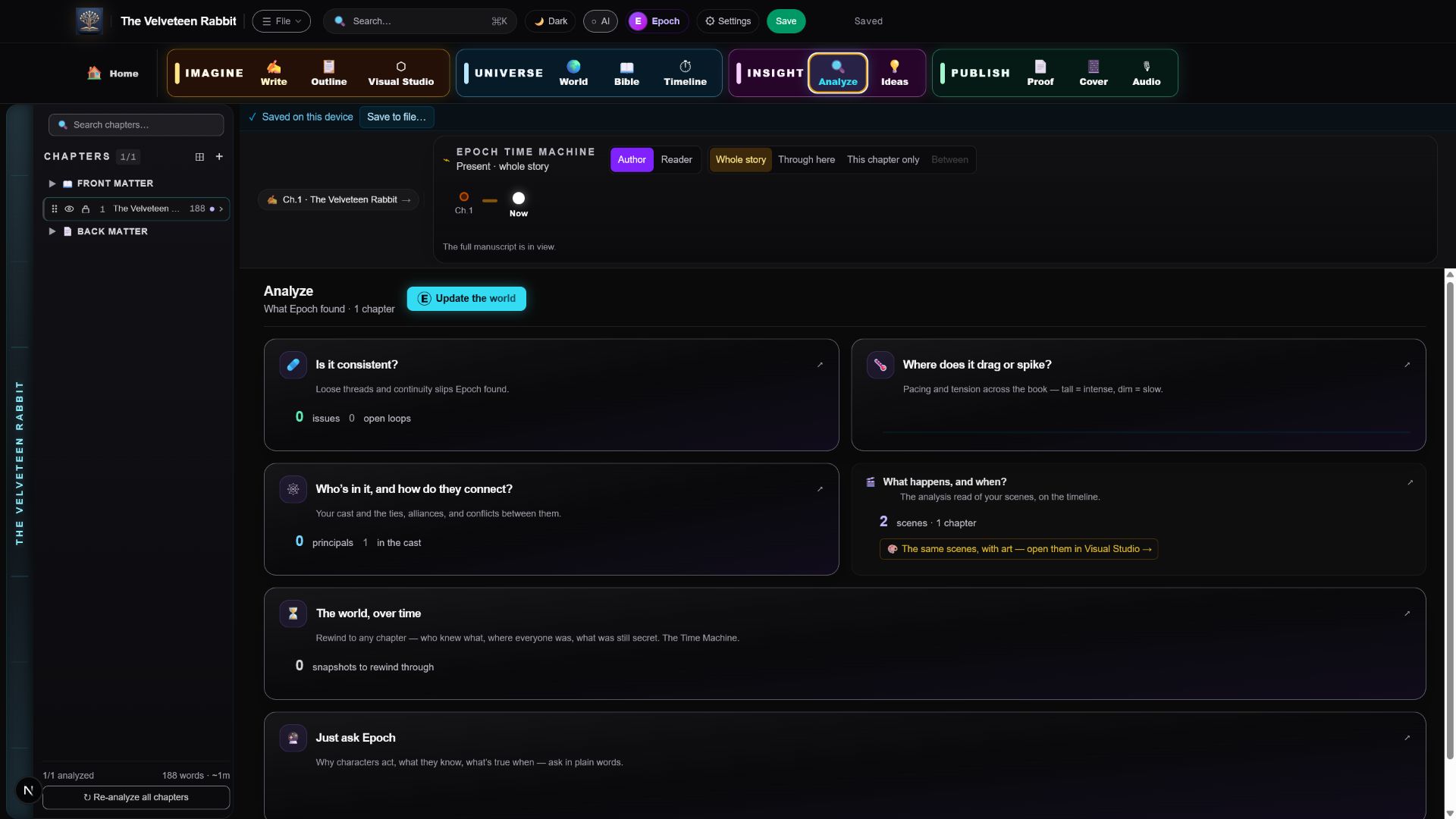
The warning is not the authority.
AI can be confidently wrong. A long manuscript can also support more than one honest interpretation. Therefore an Epoch finding is not presented as a command to rewrite the book.
The useful unit is a claim plus its evidence: what may conflict, where each side came from, and why the system connected them. The author can correct the text, reject the finding, preserve an intentional mystery, or clarify what becomes canon.
That distinction matters most when a book is complicated enough to need continuity help in the first place.
How a continuity pass fits the writing process
- Bring the manuscript.Start inside Epoch or import an existing draft.
- Build the world model.Epoch extracts people, places, events, relationships, chronology, and supporting text.
- Inspect what matters.Ask a question, run focused checks, or move through the book by character, scene, timeline, and world state.
- Judge the evidence.Confirm, reject, revise, or deliberately preserve what the manuscript is doing.
- Keep writing.The model stays connected to the book instead of becoming a forgotten document beside it.
What Epoch does not promise
It does not promise that every warning is correct, that ambiguity is an error, or that a model can replace a careful author or editor. It does not silently rewrite prose to make a dashboard green. It does not turn a changing work of fiction into a rigid database the book is forbidden to outgrow.
Epoch is designed to make the structure legible and the evidence reachable. The story remains yours.
Can continuity analysis run locally?
Epoch supports downloadable local language models on compatible hardware. That allows core AI work to stay on the author's machine after the model download. The current desktop release does not offer a hosted AI provider or a cloud API-key path.
The project remains local. Read the full explanation of local AI writing software in Epoch and the exact privacy policy.
Let the book be complicated.
Just don’t lose the thread.
Epoch Studio is preparing a direct desktop launch, beginning on Windows. macOS and Linux releases are planned. Follow the alpha and see the real product in motion.